LSM Tree
The Log-Structured Merge Tree is the core data structure in Cobble. It provides high write throughput by buffering writes in memory and flushing them to sorted, immutable files on disk. Over time, background compaction merges these files to keep read performance high.
Level Structure
Cobble organizes data files into numbered levels, where each level has different properties:
L0 (tiered) receives sorted runs directly from memtable flushes. Files in L0 may have overlapping key ranges because each flush produces an independent sorted run. This makes writes fast, but means point lookups must check all L0 files. Compaction is triggered when L0 accumulates more files than l0_file_limit (default: 4).
L1 through Ln (leveled) are strictly sorted — files within each level have non-overlapping key ranges. This means a point lookup needs to check at most one file per level (found via binary search). Each level has a target size that grows exponentially: L1 targets l1_base_bytes (default: 64 MB), and each subsequent level is level_size_multiplier times larger (default: 10×). With default settings, L2 targets 640 MB, L3 targets 6.4 GB, and so on up to max_level (default: 6).
This design — tiered L0 for fast writes, leveled L1+ for efficient reads — is a deliberate trade-off. L0 absorbs bursts quickly, while deeper levels provide the sorted structure that makes reads predictable.
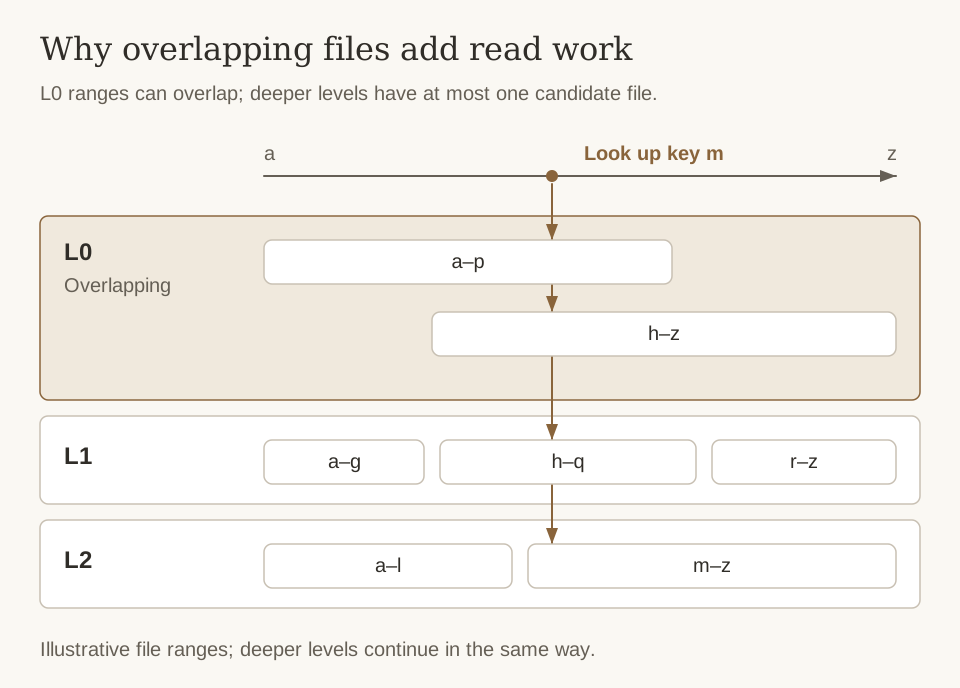
Each box represents a file’s key range. Compaction reduces overlapping files in L0 and maintains non-overlapping ranges within deeper levels, limiting how many files can contain the requested key.
File Formats
Cobble supports two output formats, selectable via data_file_type:
SSTable (default) is a row-based block format. It supports optional bloom filters for fast negative lookups (sst_bloom_filter_enabled), two-level partitioned indexes for large files (sst_partitioned_index), and per-level compression (sst_compression_by_level, default: no compression for L0–L1, LZ4 for L2+). SSTable is the best choice for general-purpose workloads with a mix of point lookups and range scans.
Apache Parquet is a columnar storage format. It provides better compression ratios and supports efficient column projection — if you only need a subset of columns, Cobble skips reading the rest entirely. Parquet is ideal for analytical workloads with large scans over wide rows, where you typically read only a few columns at a time. Row group size is configurable via parquet_row_group_size_bytes (default: 256 KB).
Multi-LSM Support
A single Db instance can host multiple LSM trees, each responsible for a different bucket range. This enables horizontal scaling within a single process: as data volume grows, Cobble can split a tree into multiple trees at a configured level (lsm_split_trigger_level), each handling a subset of the bucket key space. Each tree compacts independently, allowing parallel background work.
Version Management
LSM tree state is managed through immutable versions. Every compaction or flush produces a version edit describing which files are added and removed. The edit is applied atomically to produce a new version, while the old version remains available for any in-progress reads or snapshots. This copy-on-write approach is what enables Cobble’s lock-free reads.