Online Rescale
Cobble supports runtime online rescale: you can rebalance bucket ownership across shards without rebuilding the cluster, exporting/importing data manually, or running offline data cleanup jobs.
Practical rules:
- Start rescale after a fresh global snapshot is materialized (recommended for consistency baseline).
- During the actual handoff window, pause reads and writes briefly.
- The handoff is typically fast, and no manual data cleanup is required; obsolete data is cleaned gradually by normal background lifecycle work.
Shard and Bucket Relationship
total_bucketsdefines a fixed global bucket space (for example0..=1023).- A shard (
Dbinstance) owns one or more non-overlapping bucket ranges. - Rescale changes only the ownership mapping (which shard owns which bucket ranges).
- Buckets are the migration unit; data for moved buckets is imported from snapshot state.
Required Rescale Order
For correctness and predictable ownership transitions, use this order:
- Shrink all involved shards first
- Then run expand on target shards
shrink_bucket creates a pre-shrink snapshot and returns its snapshot id; this snapshot id is the source for later expand_bucket.
Example: 2 Shards -> 3 Shards
Assume:
- Initial:
- Shard A owns
0..=511 - Shard B owns
512..=1023
- Shard A owns
- Target:
- Shard A owns
0..=341 - Shard B owns
342..=683 - Shard C owns
684..=1023
- Shard A owns
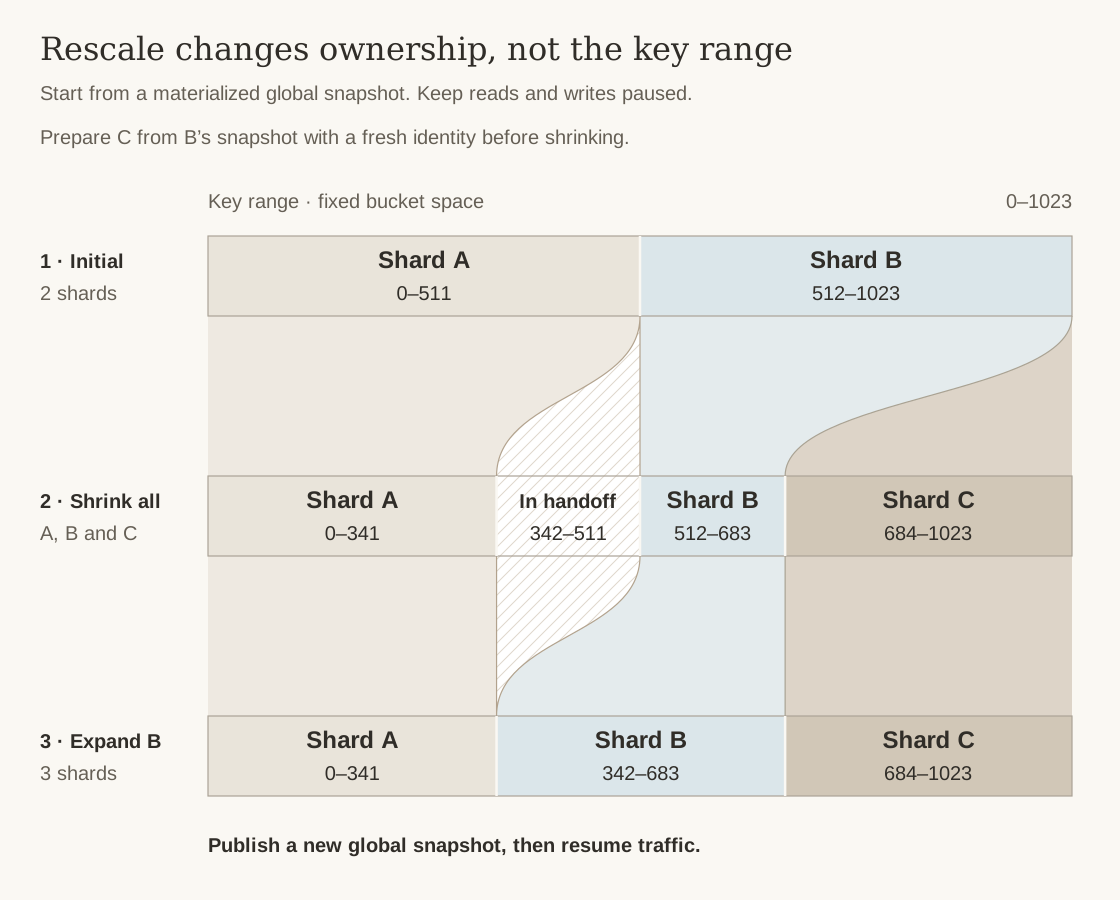
Each horizontal bar spans the same full bucket space, with segment widths proportional to the inclusive bucket ranges. The curved bands show ownership changes, not keys moving between buckets. The diagonally hatched range is in handoff after A shrinks and before B imports it from A’s pre-shrink snapshot. C is prepared with a fresh identity while traffic is paused; the final ownership map becomes the new baseline only after all handoffs and global snapshot publication complete.
Step 0: start new shard C (fresh restore from snapshot)
Use the latest global snapshot as a consistent baseline, and start shard C from shard B’s snapshot with a fresh db id:
// from latest global snapshot manifest
let shard_b_snapshot_id = /* manifest.shard_snapshots for db_b */ ;

// C is a new shard process, bootstrapped from snapshot with a fresh db id
let db_c = Db::open_new_with_snapshot(config_c, shard_b_snapshot_id, db_b.id())?;
Keep read/write traffic paused while this migration is running.
If your rescale metadata already captures the exact source manifest path, prefer Db::open_new_with_manifest_path(...).
Phase 1: shrink (all shards first)
// A gives out 342..=511 (snapshot id is pre-shrink state)
let snap_a = db_a.shrink_bucket(vec![342..=511])?;

// B gives out 684..=1023
let snap_b = db_b.shrink_bucket(vec![684..=1023])?;

// C keeps only 684..=1023 after bootstrapping from B snapshot
let snap_c = db_c.shrink_bucket(vec![512..=683])?;
Phase 2: expand (import to targets)
// B imports 342..=511 from A's pre-shrink snapshot
db_b.expand_bucket(db_a.id(), Some(snap_a), Some(vec![342..=511]))?;
Expansion defaults to asynchronous ownership adoption: the target reads the exported snapshot until its local copy is ready, and wait_for_expand_adoption is available when cleanup must wait. ExpandStorageMode::ReferencePersistent keeps the source files as durable references; ReferencePersistentWithCache additionally maintains local read caches without changing that durable reference. Java exposes the same three modes through ExpandStorageMode.
After all expands are done, take new shard snapshots and materialize a new global snapshot with DbCoordinator.